
Academic views
An exploration of inner worlds
Sculpture has undergone such a revolution over the last few decades, or more particularly since the 1950s, both in how it is made and what it puts forward on a philosophical level, that we can no longer treat it as some poor relation and assign it a perpetually limited place.
As we have shifted from modernism to post-modernism, from an industrial society to a post-industrial society, and from the rise of social and critical thought to the collapse of ideologies, we have witnessed a fundamental questioning of the accepted idea of sculpture, with the development of all sorts of notions including the weird, the random and the ephemeral, alongside the use of new materials and methods, and a different concept of space.
While retaining her own artistic autonomy, Val was fully aware of all these changes and was conscious in the advances she made in her own work of the tribute she owed to her predecessors. Sculpture is no longer limited by the demands of commemorative statuary or the constraints of blocks and pedestals: it has shifted its focus away from planes and into space, building on its inherent connection with its surroundings and operating instead as a sign. Formalism has become mainstream, but there are many sculptors on the fringes who do not see form as sufficient in and of itself and who continue to hold that there should be a close connection with reality as well as with their chosen material. Through the issues they explore in their work, they reflect on man’s place in present-day society and at the same time question what the future holds.
Val is one of these artists who share a belief in the abiding emotional power of the visual. From the very first she has produced highly stylised human figures whose meaning derives from all that she carries most deeply inside her. What she seeks to capture above all, as she stresses, however, are ‘moments’, moments caught from life, which she fixes in small, medium or large-scale open-framed bronze structures, and which reflect at once an instinct for order and a search for the absolute. For all the wit and energy she injects into the spindly figures she sets amid the commanding verticals of these imposing structures, Val does not seek to conceal an underlying sense of anxiety running through the attempts her figures make to commune, as she seeks to bring them together or at least into closer, brotherly contact. ‘To create is to open oneself up,’ she comments.
An exploration of inner worlds
Sculpture has undergone such a revolution over the last few decades, or more particularly since the 1950s, both in how it is made and what it puts forward on a philosophical level, that we can no longer treat it as some poor relation and assign it a perpetually limited place.
As we have shifted from modernism to post-modernism, from an industrial society to a post-industrial society, and from the rise of social and critical thought to the collapse of ideologies, we have witnessed a fundamental questioning of the accepted idea of sculpture, with the development of all sorts of notions including the weird, the random and the ephemeral, alongside the use of new materials and methods, and a different concept of space.
Gérard Xuriguera
Art critic and art historian

As has been made clear, contemporary sculptors have by no means abandoned the figure in their work, but they each approach it in their own specific way, according to their personal practice, medium and particular way of seeing. For Val, this consists of a blend of subtle lyricism and expressive force arrived at through multiple stages. First and foremost, she starts with clay, taking it up in her hand, feeling its weight and carefully measuring it out, and using it to form her underlying structure, then deliberately kneading and working it, stamping her imprint on its surface. This process is always governed by sensory impression rather than a slavish pursuit of likeness: mathematical calculation does not come into it, instead her shaping of form follows its own gradual and steady rhythm of development guided by her own instinctive logic. Her instinct is the product of long meditation on the meaning of form and the symbolism it conveys, through a sustained exploration and revisiting of a subject which is ever changing but constant, revolving as it does so fundamentally around human beings. There are always human figures: standing, in pairs or alone, held in place or dancing, still or balanced, sitting like Rodin’s Thinker, straddling an indeterminate structure, sleeping or in action, seen head-on, from behind, in profile. . . but rarely doing nothing. More often than not they are walking, and they are never left in total freedom: there is generally a metal structure enfolding them in its patinated rounded antler-like forms, as if to protect or simply shelter them, if not actually furnish them with a home. The detached geometry of these open structures made up of girders acts as a kind of stabiliser, making up for the unsteadiness of the protagonists, while evoking the rhythms of the urban fabric. [ + ]
The setting is integral to the action, highlighting the slender figures whose bodies are sometimes as flat and smooth as coins and who always exhibit a desire for communication, one resting an arm on another’s shoulder, for instance, one body pressing up against another, one hand on another’s hand, walking side by side, brushing up against one another, but these gestures are always chaste and never become remotely carnal, because erotic images are not part of Val’s vocabulary. What is more, each character in the action is carefully finished, with no part of their faces or bodies left untouched. There is nothing systematic about this, it is just a visceral need on Val’s part to articulate her malaise by gouging into the clay in sweeping gestures which are akin to those of Germaine Richier. A proliferation of minute marks accompanies the bigger forms as her hand pushes and pulls at the clay, jabbing and smashing it alternately, creating crags and gashes, crevasses and chutes, lending the forms a distinctly dramatic feeling. This generates a sense of isolation, of individual and collective distress, of loneliness and helplessness. The fate of the world and the turmoil within it may cry out to her, but Val never voices or lets us see her pessimism: instead, her response is to gather her groups of human figures together, set her couples hand in hand, and present them with an unmoving ballet forged in metal, whose palpable momentum offers a more reassuring note. These characters, the key actors in this two-sided performance, are never scattered randomly about, they are placed exactly where the artist chose to put them, right in the middle or on the edge of a set of structures arranged in a stabilising geometric formation, sheltering them. The structures sometimes form a trapezoidal shape and the figure is positioned at the lower end where it is in scale; others consist simply of a single larger square framework sheltering a couple on the side below, while other figures perch on a metal bar tracing out a dance. Elsewhere there is a scaffolding tower in bronze pierced with aluminium, with the inevitable little protagonists, who also appear alongside other similar structures of the same kind, but thinner or fatter, and others still in a stepped formation, with tree-like forms on either side and a pair of caryatids supporting them. Ever driven by a desire for change, Val also creates portico-shaped structures for her actors, surrounds them with rings and grids, and shows them intertwined, facing each other, back to back. In these areas, her imagination and technical mastery rule. The two work in tandem to conjure up fantastic cities, impossible towns where humankind in its smallness is set against the immensity of nature. A similar tension between nature and culture marks the steps in her career. So, after a childhood and adolescence on the move, following in her family’s wake, how is it that Val opted for sculpture, when nothing in her background could have led one to predict it? How is it that she chose to face the mysteries and vagaries of art when a fulfilling professional life in Paris was the obvious choice? And, what is more, when everyone knows the terrible conditions most artists live in? Out of a taste for adventure, defiance, naivety, provocation, or over-confidence in herself? The reasons for her choice of vocation remain an enigma, but what is life without some risk? Being an artist means a different way of life and for many it means moving to a different country, where one can reinvent oneself in the cocoon of anonymity and go on to make a name for oneself. And so Valérie Goutard took herself off far away to be reborn in art and became Val. Having spent her early years roaming across Europe, Africa and America, she cut her ties with her native country, gave up her wandering and settled on the one continent she had never lived in before, Asia, and more specifically, in Thailand. Before very long, she had acquired a spacious, comfortable, functional studio and soon enjoyed an enviable degree of success; she married Frédéric Morel, her earliest supporter, who helped her promote her work. She was ready for the future. She displayed a precocious talent, one that after just two years of training was clear not only to her but to the public who followed her. After she settled in Bangkok she did continue to make the odd trip, primarily in the cause of sculpture, travelling to Venice, for instance, where she spent time as an apprentice learning about glass from the master glassmakers of Murano and developed her sense of colour by working with this thoroughly translucent and highly refractive material, but she always came back to Thailand and to the safe haven she had made for herself in her studio there. Her choice of country may seem strange or at least unusual, because admirers of Asian art tend in general to be drawn to China or to India rather than to the former Siam, which does not have a particularly strong stamp or aesthetic identity of its own. The Thais originally came from the north, and, like their neighbours in large areas in the north, they have a tonal language and a Buddhist view of the world, although they practise the Hinayanist form of Buddhism followed in Indochina and Ceylon. The art of the kingdom is influenced by both Khmer and Burmese art and is delightfully hybrid, satisfying Western fantasies with a smiling face or a wonderful illusion of freedom. Val‘s pieces are not primarily concerned with revealing a desire for freedom, however, but rather with questioning the world, exploring its strangeness. With this end in mind, she exploits the idea of accuracy, aware that it is no more than an exercise which succeeds in illustrating the inevitable relativity of perception. Her figures therefore take on a new appearance depending on the angle from which they are viewed, making it difficult to identify them as individuals, so that in the end they constitute a single undifferentiated human entity. Be that as it may, and whatever the issues they may seek to explore, Val’s figures are her signature. Rather in the way a painter incorporates a tag somewhere in a corner of a canvas, she includes a little lost figure somewhere in a deceptively non-figurative space. She takes a structure which stands perfectly well on its own and adds a slender figure to it, upsetting our view of it and creating another reason for us to try and decipher its meaning. The effect is akin to that Taoist-influenced landscape painting of the Middle Kingdom period, which stresses man’s humility in the face of the splendour of nature. Whether they appear at the foot of a series of misty mountains whose sugar-loaf masses merge with the clouds, or stand up to their ankles in water in paddy fields, the figures in the human tragicomedy these images depict are of necessity similarly small. The difference is that this was in painting, which dominated sculpture, where monumentality was the order of the day and the focus was on a single being, in the shape of stone figures of Siddhartha Gautama, countless Buddhas and bodhisattvas carved out of the formidable cliff faces at Yungang, Longmen and many other sites, not least the largest of them all in the world, the near divine 70 metre tall Giant Buddha of Leshan. Looking at the diminutive size of Val’s figures, one could almost talk in terms of sculptural Taoism if the environment these small figures inhabited was landscape. However, nature here has been replaced by metal structures which are quasi-abstract despite having concrete titles, albeit ones which are more suggestive of metaphor than of narrative. Given that reality is an illusion, no more than an idea that we make of it, mentioning something does not mean it will actually be shown, the places are allegorical and the titles cannot make the forms in these pieces totally figurative. Invitation au théâtre, for example, is no more than a mishmash of metal squares, which are more suggestive of the shoring holding up a tunnel in a mine than of the racks on a theatre stage without wings. For the most part, it should be said, the titles do not claim anyway to describe utterly figurative environments but rather to capture atmospheres, feelings, silences, attitudes, encounters. . . Val sets her figures in barren spaces made up of the barest of forms. She combines these non-figurative forms together to create twisted structures which come across alternately as playful, fantastic, austere or expressionistic. In the midst of these liminal spaces improbable figures appear, ‘tall dwarf women’, tiny little figures so thin, with such elongated limbs, that they look like something out of a surrealist anorexic fashion show, skinny giants who have stumbled into a wild world. They wander astonished, without any depth, through structures derived from some contemporary world, but reduced to abstract forms without meaning. Maybe they have escaped from another planet, unless of course Earth as we know it has been changed into another planet. But if works of art no longer represent anything, perhaps art is a reflection of the void? For all this, as we have already observed, Val’s creatures do not necessarily display fear or despair, and there is nothing in their barely sketched faces, the eloquent springiness of their poses, their peaceful bearing, their dynamism or their inclination to interact with one another to suggest that there is any hint of conflict here. Even when they appear to be venturing onto the edge of a precipice or to be stepping out onto a high wire, these thin tightrope walkers seem free and graceful, and do not exhibit any undue anxiety, but rather a kind of lofty gravity, if not distance or reserve. Val is known to have had an affinity with Moore and Matisse, which is understandable since they both depicted the body in movement, and this takes us on naturally to the Swiss Giacometti who spent his life striving to pin down reality, going over every gesture and look minutely over and over again. With their beaten bronze look, profiles of burnt giants or tortured escapees with their skin in shreds and flesh peeling in patches, the first human forms Val forged certainly had much in common with the famous Walking Man which Giacometti made in 1960, which followed The Forest of 1950 which already looked as though it was the aftermath of a fire, with nothing left standing but charred trunks. Giacometti’s Walking Man is slender like Val’s figures, but unlike hers, has his arms hanging down by the sides of his body, inert, with nothing in his hands, his eyes are not fixed on any horizon and he is not looking for a companion. The surface texture of this very well-known work compounds the sense of heaviness projected by the gaunt, expressionless man, walking nowhere, carrying the unbelievable weight of a lost world on his shoulders. Because there is no visible setting, his condition shouts out destruction and the emptiness brought by the horror of the war. The Walking Man is a figure out of a death camp, walking away from a continent flattened by bombs or a town blown to pieces. But horror is a fate that cannot be escaped. Misery sticks to the soles of our memory. We are always either too close or too removed from others and, as writer Daniel Sibony says, ‘contemporary art seeks to bring us right up close to the distant lives we carry within us but can no longer see, so that we can appreciate their grain and texture from a proper distance.’ Given the difference in the poses, attitudes and modelling of their subjects, his motionless and distant, hers full of movement, and in their focus, his on the individual, hers on a desire for interaction, Val has not sought to replicate or reinvent Giacometti’s Man, but she has obviously not been able to ignore it either, while nevertheless remaining mistress of her own arsenal. Whether it be by chance or otherwise, her figures are peripherally descended from this ancestor, they are the children of this survivor figure, the inheritors of a world in ruins. But that world is nowhere to be seen in her work, or perhaps it has been reconstructed in the light of her vision. Fully in command of her craft, with a clear sense of her own intent and artistic purpose, backed up by a strength of character, Val sets her spindly family in a new world, made up of various materials. She discovered that she wanted to take up sculpture by working with clay, taking up handfuls of it as a primary material and working it tentatively, attacking it in different ways, respecting its rhythm while imposing her own. Subsequently she turned to other materials, notably combining her burnt bronze forms with others made of glass, revelling in the coloured transparency of the material and its sometimes smooth, sometimes undulating surface and treating its enveloping light as a form in itself. But gradually the same small-scale figures began to appear within these translucent masses, stiff with inlaid droplets and fragments of colour, standing upright, slightly bent or sitting, sometimes surrounded by a ring of bronze. ‘The existence of the bronze worlds reinforces the mystery of the worlds in glass. The light and the shadows illustrate the multiplicity of perceptible realities, and all of the materials have a trompe l’oeil, illusionist quality. They suggest a labyrinth where reference points disappear.’ Other glass pieces are made up of steps with figures either on the inside or the outside, and a mini story starts to unfold, because every composition has its own story. To force them together and initiate an interaction or bring it to a close, Val deliberately sets some figures facing others encased in blocks, like ancient prehistoric fossils imprisoned in amber concretions. Elsewhere she leaves it to their instinct to guide them towards one another. One of these pieces, made in 2016, is called Chat between two worlds, implying the possibility of having a conversation across time between the present and some distant era associated with paleoanthropology, or perhaps a more recent period, but one which has been vitrified in the way that we treat the most dangerous nuclear waste. Beneath its light exterior, the universe Val constructs perhaps hints at a hidden heaviness and the figures she introduces are perhaps a clever way of setting up a series of questions. It is worth thinking back at this point to the competitions organised in the nineteenth century by the Académie des Beaux-Arts, for the award of lucrative public commissions. Candidates could submit work of various categories including historical and mythological subjects, but not landscape. If they wanted to put in pictures of nature, they had to include the odd figure or two and give them the names of historical figures or of Greek and Roman deities so that they qualified for submission under one of the set themes. These days such official classifications no longer apply, artists have given up purely representational art and no longer have to include human figures in their works to get them accepted. A number of painters choose nonetheless to include figures in the middle of works which are otherwise not remotely representational, as if the sweeps and swirls of the compositions reflect the colour and movement of the emotions driving the faces they surround. Considered in this light, despite the gravity and somewhat melancholy tendency we have already discussed of the impassive figures in Val’s pieces, the overall mood remains one of qualified optimism in which a hope of happiness does not preclude deep inner meditation, and there is recognition that happiness is not something one lives, but something one remembers. However, it is the combination of the lively, often playful atmospheres she creates and the architectonic rigour of the settings which suggests what the pieces are about. Caught in the middle of unacted desires and unspoken fantasies, the actors in her story are anything but aggressive but come across rather as benevolent, on the edge of an interrupted daydream. But it is above all the intensity of Val’s inner vision which gives her work its enduring quality. As Arnaud Dubus has aptly put it, Val sees man as ‘a man without a face, because he is a man in a crowd, everyman, a generic being who has transcended all individual outward appearance and embodies the essence of all feeling in his deep humanity’. There is no doubt that what we have here, over and above the formal strengths which underpin it, is a reflection on man and his suffering condition, and it is this which gives it its enduring value. As for Val’s physical handling of her material, her minute, rhythmic pushing and pulling it into shape, it is neither unbridled nor completely controlled, it is simply a compromise which follows her intuitive sense of what is right. Now, there is a persistent compulsion to want to classify an artist’s œuvre, to fit it into an appropriate historic and aesthetic slot, to consign it in brief for evermore to a particular category, and furthermore it is a historian’s job to classify, to order. This is no easy matter when it comes to Val. Her visual language is marked by different elements which she often puts together: on one hand her work has a measured lyricism to it, while on the other it has a geometric quality bordering on minimalism. On top of this, it is powerfully expressive and the whole thing turns on a reality which she pursues relentlessly as hard as she can. Nevertheless, it seems to me that there is a broad term which could aptly be applied to her, given her readiness to put different materials together, and that is the word assembler. Dubuffet coined the term assemblage in 1953 to refer to the small-scale works he made with found materials. The dividing line between construction and assemblage is a fine one, but as soon as a work takes different materials and mixes them together effectively, it acquires a new status, and if on top of this it highlights the difference between the smallness of humankind and the immensity of nature it more than earns its place in the ranks of the defining trends of contemporary art. At the same time it is important to remember that Val is a polymorphous artist, not afraid to change scale and to branch out in a new direction and take up monumental art. She dismissed museums as elitist and sought to make art accessible to the greatest number by making public art in Taiwan, where she created a spectacular long undulating metal structure overlooking Taichung, and more particularly in Thailand, where she planted her tall, proud bronze figures into the seabed by the island of Koh Tao to be buffeted by the dark swirling waters. This extraordinary turbulent interaction between art and the elements could hardly fail to be striking. Gone far too soon, at the height of her career, shown all over Asia and the object of almost immediate recognition, Val leaves behind her a coherent and inventive body of work into which she put her entire being. The mini-narratives which she captured in bronze or glass also tell her story. Gérard Xuriguera
While retaining her own artistic autonomy, Val was fully aware of all these changes and was conscious in the advances she made in her own work of the tribute she owed to her predecessors. Sculpture is no longer limited by the demands of commemorative statuary or the constraints of blocks and pedestals: it has shifted its focus away from planes and into space, building on its inherent connection with its surroundings and operating instead as a sign. Formalism has become mainstream, but there are many sculptors on the fringes who do not see form as sufficient in and of itself and who continue to hold that there should be a close connection with reality as well as with their chosen material. Through the issues they explore in their work, they reflect on man’s place in present-day society and at the same time question what the future holds.
Val is one of these artists who share a belief in the abiding emotional power of the visual. From the very first she has produced highly stylised human figures whose meaning derives from all that she carries most deeply inside her. What she seeks to capture above all, as she stresses, however, are ‘moments’, moments caught from life, which she fixes in small, medium or large-scale open-framed bronze structures, and which reflect at once an instinct for order and a search for the absolute. For all the wit and energy she injects into the spindly figures she sets amid the commanding verticals of these imposing structures, Val does not seek to conceal an underlying sense of anxiety running through the attempts her figures make to commune, as she seeks to bring them together or at least into closer, brotherly contact. ‘To create is to open oneself up,’ she comments. [ + ]
As has been made clear, contemporary sculptors have by no means abandoned the figure in their work, but they each approach it in their own specific way, according to their personal practice, medium and particular way of seeing. For Val, this consists of a blend of subtle lyricism and expressive force arrived at through multiple stages. First and foremost, she starts with clay, taking it up in her hand, feeling its weight and carefully measuring it out, and using it to form her underlying structure, then deliberately kneading and working it, stamping her imprint on its surface. This process is always governed by sensory impression rather than a slavish pursuit of likeness: mathematical calculation does not come into it, instead her shaping of form follows its own gradual and steady rhythm of development guided by her own instinctive logic. Her instinct is the product of long meditation on the meaning of form and the symbolism it conveys, through a sustained exploration and revisiting of a subject which is ever changing but constant, revolving as it does so fundamentally around human beings. There are always human figures: standing, in pairs or alone, held in place or dancing, still or balanced, sitting like Rodin’s Thinker, straddling an indeterminate structure, sleeping or in action, seen head-on, from behind, in profile. . . but rarely doing nothing. More often than not they are walking, and they are never left in total freedom: there is generally a metal structure enfolding them in its patinated rounded antler-like forms, as if to protect or simply shelter them, if not actually furnish them with a home. The detached geometry of these open structures made up of girders acts as a kind of stabiliser, making up for the unsteadiness of the protagonists, while evoking the rhythms of the urban fabric. The setting is integral to the action, highlighting the slender figures whose bodies are sometimes as flat and smooth as coins and who always exhibit a desire for communication, one resting an arm on another’s shoulder, for instance, one body pressing up against another, one hand on another’s hand, walking side by side, brushing up against one another, but these gestures are always chaste and never become remotely carnal, because erotic images are not part of Val’s vocabulary. What is more, each character in the action is carefully finished, with no part of their faces or bodies left untouched. There is nothing systematic about this, it is just a visceral need on Val’s part to articulate her malaise by gouging into the clay in sweeping gestures which are akin to those of Germaine Richier. A proliferation of minute marks accompanies the bigger forms as her hand pushes and pulls at the clay, jabbing and smashing it alternately, creating crags and gashes, crevasses and chutes, lending the forms a distinctly dramatic feeling. This generates a sense of isolation, of individual and collective distress, of loneliness and helplessness. The fate of the world and the turmoil within it may cry out to her, but Val never voices or lets us see her pessimism: instead, her response is to gather her groups of human figures together, set her couples hand in hand, and present them with an unmoving ballet forged in metal, whose palpable momentum offers a more reassuring note. These characters, the key actors in this two-sided performance, are never scattered randomly about, they are placed exactly where the artist chose to put them, right in the middle or on the edge of a set of structures arranged in a stabilising geometric formation, sheltering them. The structures sometimes form a trapezoidal shape and the figure is positioned at the lower end where it is in scale; others consist simply of a single larger square framework sheltering a couple on the side below, while other figures perch on a metal bar tracing out a dance. Elsewhere there is a scaffolding tower in bronze pierced with aluminium, with the inevitable little protagonists, who also appear alongside other similar structures of the same kind, but thinner or fatter, and others still in a stepped formation, with tree-like forms on either side and a pair of caryatids supporting them. Ever driven by a desire for change, Val also creates portico-shaped structures for her actors, surrounds them with rings and grids, and shows them intertwined, facing each other, back to back. In these areas, her imagination and technical mastery rule. The two work in tandem to conjure up fantastic cities, impossible towns where humankind in its smallness is set against the immensity of nature. A similar tension between nature and culture marks the steps in her career. So, after a childhood and adolescence on the move, following in her family’s wake, how is it that Val opted for sculpture, when nothing in her background could have led one to predict it? How is it that she chose to face the mysteries and vagaries of art when a fulfilling professional life in Paris was the obvious choice? And, what is more, when everyone knows the terrible conditions most artists live in? Out of a taste for adventure, defiance, naivety, provocation, or over-confidence in herself? The reasons for her choice of vocation remain an enigma, but what is life without some risk? Being an artist means a different way of life and for many it means moving to a different country, where one can reinvent oneself in the cocoon of anonymity and go on to make a name for oneself. And so Valérie Goutard took herself off far away to be reborn in art and became Val. Having spent her early years roaming across Europe, Africa and America, she cut her ties with her native country, gave up her wandering and settled on the one continent she had never lived in before, Asia, and more specifically, in Thailand. Before very long, she had acquired a spacious, comfortable, functional studio and soon enjoyed an enviable degree of success; she married Frédéric Morel, her earliest supporter, who helped her promote her work. She was ready for the future. She displayed a precocious talent, one that after just two years of training was clear not only to her but to the public who followed her. After she settled in Bangkok she did continue to make the odd trip, primarily in the cause of sculpture, travelling to Venice, for instance, where she spent time as an apprentice learning about glass from the master glassmakers of Murano and developed her sense of colour by working with this thoroughly translucent and highly refractive material, but she always came back to Thailand and to the safe haven she had made for herself in her studio there. Her choice of country may seem strange or at least unusual, because admirers of Asian art tend in general to be drawn to China or to India rather than to the former Siam, which does not have a particularly strong stamp or aesthetic identity of its own. The Thais originally came from the north, and, like their neighbours in large areas in the north, they have a tonal language and a Buddhist view of the world, although they practise the Hinayanist form of Buddhism followed in Indochina and Ceylon. The art of the kingdom is influenced by both Khmer and Burmese art and is delightfully hybrid, satisfying Western fantasies with a smiling face or a wonderful illusion of freedom. Val‘s pieces are not primarily concerned with revealing a desire for freedom, however, but rather with questioning the world, exploring its strangeness. With this end in mind, she exploits the idea of accuracy, aware that it is no more than an exercise which succeeds in illustrating the inevitable relativity of perception. Her figures therefore take on a new appearance depending on the angle from which they are viewed, making it difficult to identify them as individuals, so that in the end they constitute a single undifferentiated human entity. Be that as it may, and whatever the issues they may seek to explore, Val’s figures are her signature. Rather in the way a painter incorporates a tag somewhere in a corner of a canvas, she includes a little lost figure somewhere in a deceptively non-figurative space. She takes a structure which stands perfectly well on its own and adds a slender figure to it, upsetting our view of it and creating another reason for us to try and decipher its meaning. The effect is akin to that Taoist-influenced landscape painting of the Middle Kingdom period, which stresses man’s humility in the face of the splendour of nature. Whether they appear at the foot of a series of misty mountains whose sugar-loaf masses merge with the clouds, or stand up to their ankles in water in paddy fields, the figures in the human tragicomedy these images depict are of necessity similarly small. The difference is that this was in painting, which dominated sculpture, where monumentality was the order of the day and the focus was on a single being, in the shape of stone figures of Siddhartha Gautama, countless Buddhas and bodhisattvas carved out of the formidable cliff faces at Yungang, Longmen and many other sites, not least the largest of them all in the world, the near divine 70 metre tall Giant Buddha of Leshan. Looking at the diminutive size of Val’s figures, one could almost talk in terms of sculptural Taoism if the environment these small figures inhabited was landscape. However, nature here has been replaced by metal structures which are quasi-abstract despite having concrete titles, albeit ones which are more suggestive of metaphor than of narrative. Given that reality is an illusion, no more than an idea that we make of it, mentioning something does not mean it will actually be shown, the places are allegorical and the titles cannot make the forms in these pieces totally figurative. Invitation au théâtre, for example, is no more than a mishmash of metal squares, which are more suggestive of the shoring holding up a tunnel in a mine than of the racks on a theatre stage without wings. For the most part, it should be said, the titles do not claim anyway to describe utterly figurative environments but rather to capture atmospheres, feelings, silences, attitudes, encounters. . . Val sets her figures in barren spaces made up of the barest of forms. She combines these non-figurative forms together to create twisted structures which come across alternately as playful, fantastic, austere or expressionistic. In the midst of these liminal spaces improbable figures appear, ‘tall dwarf women’, tiny little figures so thin, with such elongated limbs, that they look like something out of a surrealist anorexic fashion show, skinny giants who have stumbled into a wild world. They wander astonished, without any depth, through structures derived from some contemporary world, but reduced to abstract forms without meaning. Maybe they have escaped from another planet, unless of course Earth as we know it has been changed into another planet. But if works of art no longer represent anything, perhaps art is a reflection of the void? For all this, as we have already observed, Val’s creatures do not necessarily display fear or despair, and there is nothing in their barely sketched faces, the eloquent springiness of their poses, their peaceful bearing, their dynamism or their inclination to interact with one another to suggest that there is any hint of conflict here. Even when they appear to be venturing onto the edge of a precipice or to be stepping out onto a high wire, these thin tightrope walkers seem free and graceful, and do not exhibit any undue anxiety, but rather a kind of lofty gravity, if not distance or reserve. Val is known to have had an affinity with Moore and Matisse, which is understandable since they both depicted the body in movement, and this takes us on naturally to the Swiss Giacometti who spent his life striving to pin down reality, going over every gesture and look minutely over and over again. With their beaten bronze look, profiles of burnt giants or tortured escapees with their skin in shreds and flesh peeling in patches, the first human forms Val forged certainly had much in common with the famous Walking Man which Giacometti made in 1960, which followed The Forest of 1950 which already looked as though it was the aftermath of a fire, with nothing left standing but charred trunks. Giacometti’s Walking Man is slender like Val’s figures, but unlike hers, has his arms hanging down by the sides of his body, inert, with nothing in his hands, his eyes are not fixed on any horizon and he is not looking for a companion. The surface texture of this very well-known work compounds the sense of heaviness projected by the gaunt, expressionless man, walking nowhere, carrying the unbelievable weight of a lost world on his shoulders. Because there is no visible setting, his condition shouts out destruction and the emptiness brought by the horror of the war. The Walking Man is a figure out of a death camp, walking away from a continent flattened by bombs or a town blown to pieces. But horror is a fate that cannot be escaped. Misery sticks to the soles of our memory. We are always either too close or too removed from others and, as writer Daniel Sibony says, ‘contemporary art seeks to bring us right up close to the distant lives we carry within us but can no longer see, so that we can appreciate their grain and texture from a proper distance.’ Given the difference in the poses, attitudes and modelling of their subjects, his motionless and distant, hers full of movement, and in their focus, his on the individual, hers on a desire for interaction, Val has not sought to replicate or reinvent Giacometti’s Man, but she has obviously not been able to ignore it either, while nevertheless remaining mistress of her own arsenal. Whether it be by chance or otherwise, her figures are peripherally descended from this ancestor, they are the children of this survivor figure, the inheritors of a world in ruins. But that world is nowhere to be seen in her work, or perhaps it has been reconstructed in the light of her vision. Fully in command of her craft, with a clear sense of her own intent and artistic purpose, backed up by a strength of character, Val sets her spindly family in a new world, made up of various materials. She discovered that she wanted to take up sculpture by working with clay, taking up handfuls of it as a primary material and working it tentatively, attacking it in different ways, respecting its rhythm while imposing her own. Subsequently she turned to other materials, notably combining her burnt bronze forms with others made of glass, revelling in the coloured transparency of the material and its sometimes smooth, sometimes undulating surface and treating its enveloping light as a form in itself. But gradually the same small-scale figures began to appear within these translucent masses, stiff with inlaid droplets and fragments of colour, standing upright, slightly bent or sitting, sometimes surrounded by a ring of bronze. ‘The existence of the bronze worlds reinforces the mystery of the worlds in glass. The light and the shadows illustrate the multiplicity of perceptible realities, and all of the materials have a trompe l’oeil, illusionist quality. They suggest a labyrinth where reference points disappear.’ Other glass pieces are made up of steps with figures either on the inside or the outside, and a mini story starts to unfold, because every composition has its own story. To force them together and initiate an interaction or bring it to a close, Val deliberately sets some figures facing others encased in blocks, like ancient prehistoric fossils imprisoned in amber concretions. Elsewhere she leaves it to their instinct to guide them towards one another. One of these pieces, made in 2016, is called Chat between two worlds, implying the possibility of having a conversation across time between the present and some distant era associated with paleoanthropology, or perhaps a more recent period, but one which has been vitrified in the way that we treat the most dangerous nuclear waste. Beneath its light exterior, the universe Val constructs perhaps hints at a hidden heaviness and the figures she introduces are perhaps a clever way of setting up a series of questions. It is worth thinking back at this point to the competitions organised in the nineteenth century by the Académie des Beaux-Arts, for the award of lucrative public commissions. Candidates could submit work of various categories including historical and mythological subjects, but not landscape. If they wanted to put in pictures of nature, they had to include the odd figure or two and give them the names of historical figures or of Greek and Roman deities so that they qualified for submission under one of the set themes. These days such official classifications no longer apply, artists have given up purely representational art and no longer have to include human figures in their works to get them accepted. A number of painters choose nonetheless to include figures in the middle of works which are otherwise not remotely representational, as if the sweeps and swirls of the compositions reflect the colour and movement of the emotions driving the faces they surround. Considered in this light, despite the gravity and somewhat melancholy tendency we have already discussed of the impassive figures in Val’s pieces, the overall mood remains one of qualified optimism in which a hope of happiness does not preclude deep inner meditation, and there is recognition that happiness is not something one lives, but something one remembers. However, it is the combination of the lively, often playful atmospheres she creates and the architectonic rigour of the settings which suggests what the pieces are about. Caught in the middle of unacted desires and unspoken fantasies, the actors in her story are anything but aggressive but come across rather as benevolent, on the edge of an interrupted daydream. But it is above all the intensity of Val’s inner vision which gives her work its enduring quality. As Arnaud Dubus has aptly put it, Val sees man as ‘a man without a face, because he is a man in a crowd, everyman, a generic being who has transcended all individual outward appearance and embodies the essence of all feeling in his deep humanity’. There is no doubt that what we have here, over and above the formal strengths which underpin it, is a reflection on man and his suffering condition, and it is this which gives it its enduring value. As for Val’s physical handling of her material, her minute, rhythmic pushing and pulling it into shape, it is neither unbridled nor completely controlled, it is simply a compromise which follows her intuitive sense of what is right. Now, there is a persistent compulsion to want to classify an artist’s œuvre, to fit it into an appropriate historic and aesthetic slot, to consign it in brief for evermore to a particular category, and furthermore it is a historian’s job to classify, to order. This is no easy matter when it comes to Val. Her visual language is marked by different elements which she often puts together: on one hand her work has a measured lyricism to it, while on the other it has a geometric quality bordering on minimalism. On top of this, it is powerfully expressive and the whole thing turns on a reality which she pursues relentlessly as hard as she can. Nevertheless, it seems to me that there is a broad term which could aptly be applied to her, given her readiness to put different materials together, and that is the word assembler. Dubuffet coined the term assemblage in 1953 to refer to the small-scale works he made with found materials. The dividing line between construction and assemblage is a fine one, but as soon as a work takes different materials and mixes them together effectively, it acquires a new status, and if on top of this it highlights the difference between the smallness of humankind and the immensity of nature it more than earns its place in the ranks of the defining trends of contemporary art. At the same time it is important to remember that Val is a polymorphous artist, not afraid to change scale and to branch out in a new direction and take up monumental art. She dismissed museums as elitist and sought to make art accessible to the greatest number by making public art in Taiwan, where she created a spectacular long undulating metal structure overlooking Taichung, and more particularly in Thailand, where she planted her tall, proud bronze figures into the seabed by the island of Koh Tao to be buffeted by the dark swirling waters. This extraordinary turbulent interaction between art and the elements could hardly fail to be striking. Gone far too soon, at the height of her career, shown all over Asia and the object of almost immediate recognition, Val leaves behind her a coherent and inventive body of work into which she put her entire being. The mini-narratives which she captured in bronze or glass also tell her story. Gérard Xuriguera
Interview with Val by François-Bernard Mâche
31st of March 2014
F-B.M. : In your biographical data, you mention a decisive encounter for you who came from a completely different world than sculpture. I would like to know more about this encounter.
VAL : She is a person who means a lot to me, I see her every time I come to Paris.
F-B.M. : She is a sculptor herself ?
VAL : After training as an auctioneer, she did sculpture, and today she designs jewellery. They were neighbourly relations at the beginning, we got on well. I was a bit blown away by her culture, which I didn’t have at all in the field of sculpture, painting or antiques. In fact, we spent some really good times together and, one day, she got me to do some sculpting, some modelling. It was like a revelation. My love for sculpture was born in a completely immediate way.
F-B.M. : So, as an adult ?
VAL : Yes, I must have been 33 to 35 years old.
F-B.M. : Without there having been, during your childhood, temptations to tinker, as with many children …
VAL : Indeed, and I was never spotted by any art teacher (laughs).
François-Bernard Mâche
Composer. Elected member of
the French Academy of Fine Arts

F-B.M. : It is quite extraordinary, it is generally said that sculptors are people who mature slowly, that they don’t get there until they are about fifty. You have cut corners, you started late but arrived earlier than the others.
VAL : But I think that the maturity acquired during my previous life was extremely important, because there are several things : there are the hours spent at work, but also the personal experience of the man or woman who has something to say, and I think that all the years before allowed me to burn the stages in terms of maturity of the person. I was caught up in a kind of urgency and need to make up for lost time, which meant that I worked enormously, really enormously, during the last twelve years, which are my years of sculpture.
[ + ]
F-B.M. : It is a completely original path. So, apart from this contact with this friend, you are almost completely self-taught ?
VAL : Yes, almost completely. With this friend, I took classes for a year, one morning a week, with a sculptor and painter not far from home. It was she who helped me to make the only bronze I casted in France. But in fact, my great school of sculpture was at the foundry in Thailand where I corrected all my lost waxes. For years I spent two or three days a week at the foundry and there I learned a lot from all the workers. Up until then, I had received encouraging feedbacks on my first sculptures, made of clay at the time.
F-B.M. : Did you practice modelling ?
VAL: Yes, clay for two or three years. But with wax, I finally assemble with the same modelling techniques. My work is a work of addition of matter and not of sculpture in the mass which I have never practised.
F-B.M. : You have abandoned the use of clay ?
VAL : Yes, because it turns out that in Thailand the climate is very hot, so the clay sculptures dry too quickly. Moreover, very quickly, I turned towards rather thin figures, and architectures for which clay is not at all suitable as a material.
F-B.M. : Apart from, or after, this revelation of materials and your desire to manipulate them, did you also discover a whole previously ignored world, to which you would have to refer or oppose, that of other sculptors such as Germaine Richier, or Giacometti ?
VAL : Not really. After this initial encounter, I left France, and I felt much freer to initiate a new path. It would have been much more difficult in France, where I was not seen as a sculptor. But when I arrived in Thailand, I positioned myself as a sculptor from the outset, and as a result, in the minds of those around me, I was one … When I started out, I always considered that my lack of culture in the field of sculpture was a blessing, because it allowed me to go absolutely freely in the direction I wanted.
F-B.M. : You preferred not to know what others were doing ?
VAL : Exactly, until you reach a little more maturity, where, afterwards, what others do can continue to fuel a reflection, once the journey is already initiated.
F-B.M. : What you are telling me is very surprising, but I understand you. You are initially a bit like the artists who are wrongly called naive, that is to say who do not want to know any references a priori, and who especially want to bring out something from within themselves.
VAL : Absolutely.
F-B.M. : Has this been maintained until today, this desire not to worry too much about what others are doing or about what has gone before … ?
VAL : I am starting to be more opened to what others are doing, because I also feel more confident … When I entered a path that was not at all premeditated, I didn’t have fabulous self-confidence, and as a result, when you look at the great masters, you can feel like …
F-B.M. : One can be afraid of being inhibited ?
VAL : Yes, because in fact, one must already feel that one is following one’s own path in order to be able to say to oneself : “whatever this path is, we are there, we are well there, and we want to continue to dig it and pursue it”. Only then could I begin to open up more to the culture of the field of sculpture. But at first, I considered it as a chance to travel without luggage.
F-B.M. : Legend has it that Correggio, on discovering Raphael’s paintings, exclaimed: “Anch’io son pittore”. Your revelation was not quite of the same order. It was not by discovering an existing sculpture, but by manipulating the material yourself, that it all began. But it was also a stimulus from outside, that encounter.
VAL: Yes, certainly.
F-B.M. : But it wasn’t a reference, that is to say that the person in question didn’t become the ideal sculptor ?
VAL : No, not at all, but she continues to bring me a lot, for example, recently she took me to see Bill Viola’s exhibition, which I didn’t even know by name, and which gave me a very strong emotional shock. But it is more literature than visual works that have nourished me since my childhood. For example, to take a recent example, François Cheng’s “Five meditations on beauty”, which seemed to provide words to explain my work.
F-B.M. : So a literature of reflection rather than fiction ?
VAL : Yes, but only for two years. Before that, I was more into fictional literature.
F-B.M. : François Cheng is someone who has reflected on Chinese culture in particular.
VAL : Yes, but since his twentieth year, he has adopted France and built bridges between the two cultures. His “Five Meditations on Beauty” was a shock for me. Afterwards, I also read “Five meditations on death”, which takes up his themes, a book on calligraphy. He wrote novels that I also reread. As a result, I was able to explain my architectures, with these spaces, these plains and voids, as a kind of rhythm that sets man in motion, like an impulse that emerges from the earth and makes us get up in the morning to do what we have to do. By reading his books, I put much stronger words on what this can be, with the notions of yin and yang, of median emptiness with the energy that can circulate and of balance between man, architecture and the world that surrounds him.
F-B.M. : You yourself have become in a certain way an Asian sculptor since you moved to Bangkok ?
VAL : Yes, one can say that, while always remaining a foreigner on this continent and in this country where I feel so well that I will probably end my days there.
F-B.M. : It is a way of being free, of remaining free.
VAL : Yes, it is a way of being free.
BMF : So you are a citizen of the world.
VAL: It is nice, but yes.
F-B.M. : I would now like to collect your reactions to some of the works, in order to better understand yourself. For example, here is a small bronze of Indian tribal art. How do you see it ?

VAL : For me, it is a kind of totem, and what I find are characters who are part of the world in the same way as a tree …
F-B.M. : Yes, that is why I thought of you. I thought there might be some affinities.
VAL : Yes, absolutely. There is this play of plain and empty spaces that makes it possible to see through the sculpture and for me it is a way of integrating the world, of saying that the existing world is part of the sculpture. It is full of poetry.
F-B.M. : It is certainly also full of allusions to a belief system, a thought system, that I don’t know. This tree must have a meaning in their traditions.
VAL : There is a kind of chain of humans too.
F-B.M. : It proliferates, I counted : there are seventeen characters.
VAL : I like this idea too : we are alone in relation to our own imaginary world and at the same time I find, in a very curious way, that it is when we open up, when we look outside, that we realise that many people, in an isolated way, are going in the same direction, and for me I have the impression of taking part in a chain that is totally beyond us. For example, with Bill Viola, I also find that there is a very mystical side to everything he does, questions about death, about the baggage we carry with us, and this ties in with François Cheng’s idea, which is very beautiful, in which he talks about life taking on its incredible strength through the inevitability of death, and which suggests that instead of looking at death from the side of life, we should look at life from the other side, and say to ourselves : Well then, what meaning do we give to our life in order to be like a ripe fruit to which we have brought all the possible richness at the moment when the passage is made. And all these notions of a man who has his destiny moving forward, who doesn’t necessarily know where he is going, but who moves forward relatively serenely amidst all the turmoil, speak to me a lot.
F-B.M. : I understand what you are saying, but then to the question I would like to ask, I can perhaps guess your answer : are there any artists, Bill Viola or sculptors or anything else, that you would like to meet ? Would you have something to say to them ? Or does your vision ultimately belong to an inner dream, without others being able to contribute anything other than a kind of figuration ? Are you waiting for someone to reveal something essential to you ?
VAL : Essential, no, not at all. As for meeting artists like Bill Viola or François Cheng, I would feel quite intimidated in front of them already, but yes, yes, I would be quite passionate about what they could say and I would have something to say to them. There is something that has carried me a lot over these twelve years of sculpting, and that is the external view of others on my work. To be completely honest with myself, if at a certain point I hadn’t had positive looks at my work that carried me, that took me further each time, I don’t know if I would have had this need to create that I didn’t have until I was thirty-three. I’m not sure.
F-B.M. : Yes, the gaze of others, success, is important as an encouragement and confirmation.
VAL : And beyond that, the idea that my work, which corresponds to an inner and very intuitive vision, that’s for sure, is also something that others recognise a lot. I think that is what gives strength to what I do. I feel a bit separate and in my own bubble when I work and when I was younger. But at the same time, I feel very reassured to be able to say to myself that tons of people feel that way.
F-B.M. : Yes, because in today’s art this importance given to the human being has declined a lot. It has even become rare, finally.
VAL : Yes, it has become much more intellectual, I think.
F-B.M. : There are indeed many more installation artists and false philosophers than real painters.
VAL : I am a sculptor, I am not a philosopher, I am not a writer. But I believe that arts that are different from ours enrich, bring something to the table, fuel a reflection. There is an artist I like very much, without having seen many of her paintings, but whose books I have also read, it is Fabienne Verdier.
F-B.M. : Who does giant calligraphy.
VAL : Yes, but it is painting.
F-B.M. : That’s right. This leads me to ask you about something I had planned to mention later, but never mind : colour. Sculptors are a priori people for whom colour is not a determining factor, but it seemed to me that in your productions from the end of the 2010s onwards, you were introducing a research on patinas, on quite marked colours.
VAL : I do think that the colour of the patina has a lot of influence on the final perception of the piece. That is to say, there are colours that will soften the angles, there are colours that will make something stronger, in the tones between very dark and lighter, there are really things that happen. I have been experimenting, and there are years where I have actually tested reds, greens, blues.
F-B.M. : Yes, around 2009-2010.
VAL : In fact, for me, it was too marked. I think that in fact we need to go towards something more subtle, and today I am very lucky to have two peoples in my team with whom we collaborate to really define where we are going in terms of patina. We took the time to do researches and, as a result, today, I sometimes think of a certain type of patina for certain pieces and sometimes I say to myself that it doesn’t suit, to go in another direction, to start again, and finally to do something else.
F-B.M. : There is another technical question I would like to mention : volume. It seems to me that for many of your sculptures it is not necessary to turn around, and that the main viewpoint is two-dimensional. Is that right ?
VAL : It depends, no I wouldn’t say that. For some of them, yes, especially in 2D, because in some cases I like to add a shadow projected on the wall linked to the sculpture. Here, we are completely in two dimensions. But there are some pieces like Ville fantastique or Attrait de la liberté which are really three-dimensional. In any case, what seems important to me when you see a sculpture or a painting, when you read a book or listen to music, it is not the choice of a technique or a principle, it is that there is an emotion that comes out of it, that there is an interaction between the person who is looking or listening and the object being looked at, and that there is a sort of dialogue that is created between the two.


F-B.M. : Yes, conceptual art is perhaps the furthest thing from that.
VAL : Indeed, I am not in that movement at all.
F-B.M. : I would like to go a little deeper into this interesting idea of dialogue that you mentioned.
VAL: What always strikes me is that people who look at my work project themselves and imagine stories.
F-B.M. : That is what I wanted to talk to you about.
VAL : Today, what I want to say about what guides me, and which comes from certain reactions that I have been able to provoke, and that I have found interesting, is a sort of search for balance in imbalance. It is, although things may seem chaotic at times, to nevertheless find a kind of balance that is put in place with a notion of hope on the other hand. I have sculptures that are perhaps more joyful than others but there is never despair.

F-B.M. : You surprise me, because I have found certain situations in your sculptures disturbing. In La traversée, for example, what brought the characters up there and why do they take such a risk to jump ?
VAL : I will tell you the idea that led me to this sculpture. It is a couple that I knew a little bit but not much more than that, and suddenly we learned that the husband had died, and so I called this woman I knew a little bit to manifest myself. I felt that she was so strong with her two teenagers with her that I thought she would overcome the obstacle and that she had the strength to survive the ordeal. So for me this sculpture means that in life we have hardships that can be very strong, but that with time and life’s surprises we can overcome the ordeal, and potentially grow from it. A psychologist who saw this sculpture at a trade fair where I was telling her about it, told me that the second pendant or screen was higher than the first and for her it was really the idea that when you manage to overcome an ordeal, you finally grow out of it. For me, there is no despair in this sculpture at all, I feel that they will reach the other side.
F-B.M. : As the title says, they will cross over, not fall into the void.
VAL : That is it. But everyone has their own interpretation : for some they will fall, for others they will cross … For my part, what I liked in this sculpture was this idea of the fragility of the characters in relation to these two plinths which are relatively moved, tortured in their modelling.
F-B.M. : And in this sculpture Seated on a coconut branch, or in Walking on a twisted pedestal, these characters perched in the middle of nowhere, without us guessing how they were able to get up there or how they are going to escape, doesn’t the thin support evoke a trap rather than a pedestal ? They make me think of Topor’s character, forever sitting on a console in the middle of a vertical wall that he can never leave … Why do you sit on a coconut tree ? Does it correspond to something, to a precise memory, or is it purely imaginary ?


VAL : It is purely imaginary, and for me this character up there who seems to be making speeches, we don’t know if he is talking to a crowd, if he is talking to himself, or if he is crazy up there. But in my opinion, he is not desperate because the attitude of the character is not sad, even if with our rationality we wonder what he can do up there …
When I talk about hope, in fact, for me it is the duality of fragility and hope, and I think that when everything is going well, when we don’t ask ourselves any questions and life goes on, the notion of hope loses its salt. For me, the fragility that we feel in ourselves during the events that affect us means that, fortunately, we have the counterweight of hope behind us which can help us to get through the stages and overcome the hardships.
F-B.M. : And for you, this hope can take the colour of humour, that is to say a way of smiling at what is not cheerful in itself ?
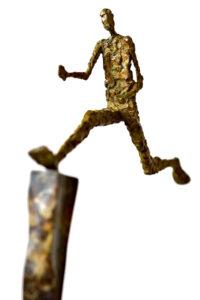
VAL : Yes, but not in everything. As I have a very intuitive work, in the end it corresponds a lot to stages in life. There are periods when my characters were more situated in an expectation. There I was in a transitional phase of my life, trying to position myself. There were more euphoric periods with, for example, Theatre of joy.
F-B.M. : Your characters are often thin, but generally agile, or even acrobatic. Quite different in spite of their elongation and thinness from that disturbing Etruscan statuette that has been nicknamed “the evening shadow”.
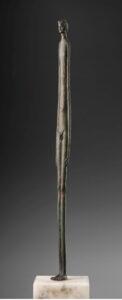
VAL : It is true, for me my characters are in attitudes that are very human, they may be relatively thin and relatively fragile, they have calves, they have a head tilt … They speak of life, not death.
F-B.M. : And I see them most often in movement and standing. Verticality seems to me to be a constant in your works, even if a small minority sometimes evoke still water. The architectures they inhabit, where they circulate, are like them very slender, and always opened. Tell me about your architectures, for example the one in your Autoportrait.

VAL : For me this play is a representation of the multiple facets of any individual and I put each character on a little spur that allows them to be reoriented. There are three characters, including a character under the staircase which is like a relatively dark inner world. That doesn’t mean he is sad, but relatively protected, at least like a certain hidden side of our thoughts. The three characters can actually be interchangeable, and some of them are more in motion, some are more still, stopped there, you can make them look towards the bottom staircase or towards the horizon.
F-B.M. : They can really move ?
VAL : Yes, you can really swap them and rotate them. So there are stairs that intersect, there is this idea of passage, there is this idea of voids and plains that gives a certain rhythm, which, associated with the stairs, gives the idea of windows, of openings to the outside. For me, this sculpture came about without any a priori idea, I didn’t make any preparatory drawings, I just started something and there it was. I called it Autoportrait, but I hadn’t originally planned to make a self-portrait. I gave it this title because there are themes in this sculpture that are very important to me : rhythm, multiple facets, the power to feel things differently at different times in our lives, these ideas of stairs that cross, of passage, of opening outwards, of ascension. It is a very European notion, very Western, this idea of ascension, the verticality that you noticed. In the West, we want our life to be an upward journey. We are attracted to the surpassing of ourselves, whereas Asia is more about circles and cycles.
F-B.M. : That is it, that is what we perceive in you. On the other hand, one can feel differently about these open-air architectures. Rather than being protective, they are, as you said very well, open to the outside. There is still a certain amount of protection but it is not very pronounced. In short, you are open to the outside because you don’t expect any danger from it a priori …
VAL : Absolutely.
F-B.M. : … but rather something interesting to see. All your houses are glass houses, with windows through which one can see outside. That is a big difference with Etienne Martin’s, which are closed.
VAL : Yes, when I spoke of the quest for freedom by going to live abroad, because we are in a certain cultural environment which has its codes, its values, and which tends to format us, I also meant that opening up to the outside world allows us to sort out the values on which we will rely all our lives and these codes which format us but which are not so important. Opening up to the outside world allows me to eliminate what I felt during my youth was more imprisoning than interesting. But it took me a long time to get out of it. I think being abroad, meeting different people, being away from a family that I love but that has a strong influence, has allowed me to try to choose for myself what will nourish me, rather than being in an environment that provides you with a certain kind of food.
F-B.M. : Everything is now open, but still sometimes fragile ?
VAL : Certainly fragile, yes.
F-B.M. : In La molécule habitée, for example, if you think of it as an architecture, it could be an architecture at risk of collapsing ?

VAL : For me this sculpture expresses a notion of infinity.
F-B.M. : It is true that it forms a sort of ∞, the sign of infinity.
VAL : I didn’t think of that. But perhaps it would be like the Little Prince on his asteroid. That is to say, there is the space that is really part of the sculpture and takes up a huge amount of space compared to the bronze solids which are relatively small.
F-B.M. : La molécule habitée is an interesting title.
VAL : I think it was Philippe Staib who told me that it reminded him of a molecule when he first saw the sculpture and it suited me well in this idea of infinity. In fact, for me, it is a man who is certainly small in relation to the universe, which is totally beyond him, but that is not why he is going to be out of balance.
F-B.M. : There is not the somewhat pessimistic idea of the human being as a microbe that infests a molecule.
VAL : Not at all (laughs).
F-B.M. : How do you reconcile both the importance you give to humans, and the general lack of faces or even identification between men and women ?
VAL : From time to time I make a couple, and still … but for me what is important is the human being. He has no face because in the end he can be anyone. I will work a lot on attitudes, on a head movement, on a leg movement, on a hand, and so for me it is as if I were going to seize a moment, an attitude, where I say to myself “there is something alive there”. If there is no face, it is because I am not going to represent anyone in particular. I am interested in people as such, with their astonishments, their questions, their doubts and their hopes. The questions I have, many people have them too, each one has its own way of dealing with them, but in the end we are all asking ourselves what is the meaning of our presence in this world, the meaning of this world which is here, and which is of extraordinary beauty.

F-B.M. : This quest for balance is evident in a sculpture that is quite different from the others, which you call Inle balance II. I recognised in it the strange way of rowing with one leg that only the fishermen of this Burmese lake have.
VAL : There is a notion of balance, yes. They were holding the nets with their hands, rowing with one leg, and it was extremely peaceful in the early morning with a beautiful mist on the lake. It was this notion of balance that I wanted to portray, with the serenity of a man who is well in his own world.
F-B.M. : That is right. But in your work he’s not rowing. Unlike some of your characters who move a lot, he is in fact in a balance that simply suggests an oscillation.
VAL : And that if you take it away, the sculpture will fall.
F-B.M. : Oh yes, I hadn’t thought of that. This sculpture is not fixed on a base, it oscillates, right ?
VAL : It doesn’t oscillate, but it has a real balance, it stands like this, it has this rounded impression on the bottom of the sculpture.
F-B.M. : Now I am tempted to ask you the same question as with other of your sculptures: what happened before, what will happen after ? Or maybe this time nothing will happen afterwards, if man has found his balance ?
VAL : He has found his place.
F-B.M. : In several of your works, we see acrobats. Characters seem to be enjoying themselves, in risky situations or positions. Is artistic creation also a game for you ?
VAL : It has to be a good time, it has to be a happy time. Yes, so in that sense I could say that it is a game, or rather that I practice sculpture joyfully.
F-B.M. : “Game” has several dimensions …
VAL : It depends. There are days when I feel very cheerful, so overall it becomes a game. Other days I am less so, and sculpting is less so.
F-B.M. : The game is not always a time of extreme cheerfulness, there is also the game where you play out differences to see if it will work or what will happen.
VAL : So in that sense, absolutely yes, it is a game. I create architectures and people that I will put together, but there are necessarily cases where it is sometimes the people who come first, or sometimes the architecture. And then, at some point, things will come together and work, but there is no rule that it’s necessarily the architecture that I do first and the people later. It depends. Either I will create a character, and then I will look for the environment that suits him, or I will start an architecture and then I will put life into it, and in that sense, with my characters, I can really play with them like puppets. I will make waxes to create new characters and I will change an attitude, move an arm …
F-B.M. : One of the reasons why you are not a priori attached to “3D” is perhaps because sometimes you use the characters as puppets, with a projection of their shadow.
VAL : The projected shadows add an extra dimension of reading.
F-B.M. : You evoke a certain optimism, sometimes a cheerfulness. Is there a link with the Buddhist context in which you live daily ? Is the joy that sometimes appears in you a joy of the order of the Buddhist joyful serenity ?
VAL : It is not thought of that way. But I have been in Asia for ten years now, and of course there is an influence. The idea of the cycle, which is so strong in Asia and in Buddhism, is an idea that appeals to me. The rhythm with my fullness and emptiness, in my opinion, really comes from this crossroads between the East and the West. So, from time to time, I am more vertical, it is more the remanence of the West where you have an idea of surpassing yourself, the desire to go further, always further. And next to that there is a peaceful and joyful aspect which really exists in Asia and which has influenced me a lot. My notion of time in Asia has completely changed.
F-B.M. : Because at the basis of Buddhism there is the idea that earthly time …
VAL: You always have a new possibility to remake yourself …
F-B.M. : But that it is also fundamentally about escaping from all that is painful about it.
VAL : Yes, that too, of course …
F-B.M. : Buddhism also expresses an unfavourable view of life as a source of pain. So there is a mixture of tranquillity because nothing is definitive, and then the hope that one will manage to escape the cycle of reincarnations, time, because it is still essentially a source of pain.
VAL : Yes, I totally agree with that and I would add, a source of acceptance of this pain, with the hope that the new life will be more forgiving with us.

More to explore


